It is a sad fact that, on average, investor returns underperform reported fund returns because media noise and short-term performance reporting fuel investor fear and greed. As an investor, to improve the chance of earning a fund’s targeted return, you need to understand your investment manager’s investment approach and ensure that your timeframe for investing is aligned with theirs.
‘Individuals who cannot master their emotions are ill-suited to profit from the investment process.’ Benjamin Graham
US research shows that investors underperform the funds they invest in over time.
The reason for this underperformance is called the behavioural penalty. Investors tend to lose out because they chop and change their investments in response to the latest news rather than remaining invested. Peter Lynch, manager of the Fidelity Magellan Fund, which delivered a compound annual return of approximately 29% between 1977 and 1990, found that the average investor in the fund only earned 7%. Other research shows that this phenomenon is widespread (as shown in Figure 1). Investors, on average, earn substantially lower returns than the funds they are invested in. Although our examples are based on US research, there is no reason to believe that the outcomes for investors in South Africa are any different. Investors are, on average, likely to underperform the investment industry’s reported returns.
Figure 1: Average fund return compared to average investor return (1994-2013)
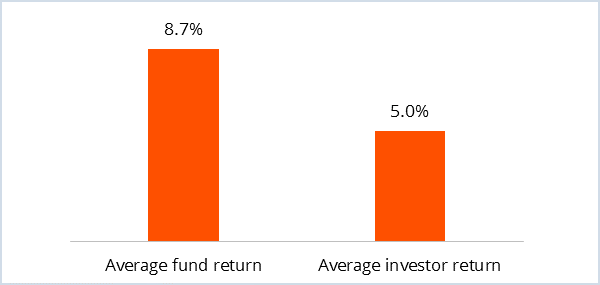
Source: Quantitative Analysis of Investor Behavior by Dalbar, Inc. (March 2014) and Lipper
Each investor must decide what philosophy or approach to investing makes sense.
You first need to be clear on which characteristics you think are responsible for generating returns, because it will inform how and with whom you invest. This is important because if you say, invest in a business, it may take time for the specific underlying characteristic(s) of the business to overcome other short-term factors (like a change in the currency, interest rates, or weather patterns as examples). You need to be patient and allow sufficient time for these characteristics to generate returns. This also applies to investing in a fund, where the investment manager holds certain beliefs about the characteristics that will generate returns from their chosen investments. One cannot simply look at the most recent performance data to inform an investment decision. The reason is because an unexpected change in interest rates, exchanges rates, or any other short-term and unpredictable events may temporarily flatter or depress the investment outcomes. Unfortunately, however, it is the much-publicised short-term returns and focus on the latest news that feed investor behavioural biases and undermine long-term returns. Switching between fund managers based on recent performance (‘buying high and selling low’) is a large contributor to the behavioural penalty investors suffer.
There are many different investment philosophies and styles.
Momentum (buying what’s been going up in price), growth (buying businesses with good growth prospects), quality (buying high-quality businesses) and passive (buying all the businesses in proportion to their size), are just a few examples.
At Denker, we are long-term investors who embrace value investing.
Below is a brief explanation of our investment process, and what we mean when we say that we are long-term investors who embrace value investing.
1. Identify and evaluate profitable businesses.
Some businesses are simply more profitable than their competitors. Identifying these businesses is the first step in the long-term value investor’s process.
- A business may have sustainable cost advantages that give them a meaningful advantage over their peers.
In South Africa a simple example is mining. All platinum mines sell the same commodity at the same price in the market. However, some mines are open cast and other mines are deep level mines. Open cast mines have lower operating, maintenance, and safety costs than deep level mines. Therefore, the open cast mines have lower unit costs than deep level mines and will make more profit per unit. Every rand invested is therefore more productive and profitable in a low-cost mine than in a high-cost mine. - There are also businesses that have a revenue advantage.
They can charge a premium for their products (think Apple’s iPhone versus Samsung’s Galaxy). Apple doesn’t necessarily have a cost advantage when it comes to its mobile technology. It probably costs around the same to produce an iPhone or a Galaxy, but the business is more profitable because iPhones sell at a premium to the Galaxy. The latest iPhone X sells for around $999, while the latest Galaxy S8 sells for around $725. A business with this type of revenue advantage, whether it is the result of reputation, brand and/or quality, will make more profit than its peers that don’t have this advantage. Again, every dollar invested by Apple in its mobile phone business delivers superior returns to a dollar invested by Samsung in its mobile phone business. Aside from this example that compares Samsung’s mobile technology with Apple’s, in another article, we explain why Samsung Electronics (which has other more competitive and profitable divisions) remains one of our top 10 investments in the SIM Global Emerging Markets Fund. - Evaluate the durability of their competitive advantages.
Competition in the market place for happy customers, the source of profits, ensures that there is continual innovation. As Jeff Bezos, the founder of Amazon, explained, ‘your margin is my opportunity’. Exceptional businesses are always at risk. A business with an advantage today could find themselves without a market tomorrow. Music distributors found themselves displaced when consumers opted for $1 songs from iTunes instead of $9 CDs. Kodak, an iconic brand, disappeared with the introduction of the first digital cameras and eventually smartphones. The list of exceptional businesses that have disappeared is long, but the lesson is simple. Don’t ignore competitive threats when evaluating the ability of a business to earn excess profits.
2. Acquire these businesses at attractive prices.
Just about everything else in the Denker investment process is aimed at reducing the risk of making mistakes in identifying and pricing opportunities. As Benjamin Graham, Warren Buffett’s finance professor, summarised in his book, The Intelligent Investor, ‘for 99 issues out of 100 we could say that at some price they are cheap enough to buy and at some price they would be so dear that they would be sold’.
If you would like to learn read more about our investment philosophy, and investment process, we encourage you to click on these links.
If you aren’t sure which approach suits you, diversify, but don’t keep switching.
We urge you to become acquainted with the different investment approaches, to get professional advice so that you understand why these strategies will or won’t deliver performance over the long term. If you don’t know what drives long-term equity returns, then the most sensible approach is to diversify and allocate your investments to a range of different strategies or to invest in passive alternatives. Trying to switch between different strategies, like momentum, growth and value, is almost guaranteed to result in underperformance. Materially, the most profoundly negative impact on investor returns takes place when investors respond to emotion and lose faith in their chosen investment philosophy and process after short periods of underperformance.
Madalet Sessions
Disclaimer
SCI stands for Sanlam Collective Investments.
Denker Capital is an authorised Financial Services Provider, and an appointed investment advisor to Sanlam Investment Management (Pty) Ltd an authorised Financial Services Provider. The information in this communication or document belongs to Denker Capital (Pty) Ltd (Denker Capital). This information should only be evaluated for its intended purpose and may not be reproduced, distributed or published without our written consent. While we have undertaken to provide information that is true and not misleading in any way, all information provided by Denker Capital is not guaranteed and is for illustrative purposes only. The information does not take the circumstances of a particular person or entity into account and is not advice in relation to an investment or transaction. Because there are risks involved in buying or selling financial products, please do not rely on any information without appropriate advice from an independent financial adviser. We will not be held responsible for any loss or damages suffered by any person or entity as a result of them relying on, or not acting on, any of the information provided.