In this article, Denker Capital’s Head of Multi-Asset, Madalet Sessions, examines how the role of US sovereign bonds has shifted from a reliable safe haven to no longer behaving like the defensive anchor investors once relied on, and what this changing relationship means for portfolio resilience.
This article first appeared in Glacier’s Funds on Friday newsletter.
I started working in financial markets in 2006. For most of the period since then, during which I’ve developed my understanding and intuition of markets, the US sovereign bond market was a remarkable safe-haven asset. In good times, when equity markets were delivering attractive returns, investors would earn a positive return from the bond market (in dollars). And, in times of market stress, or risk aversion, the bond market would gain in value as real yields and inflation compensation would decline.
Table 1 shows the returns for developed markets equity (the MSCI World Index), emerging markets equity (the MSCI Emerging Markets Index), the US sovereign bond market (US 10-yr bonds) and the dollar index (DXY) after the bursting of the dotcom bubble, the global financial crisis and the Covid-19 pandemic shock.
Table 1: US dollar returns during times of stress
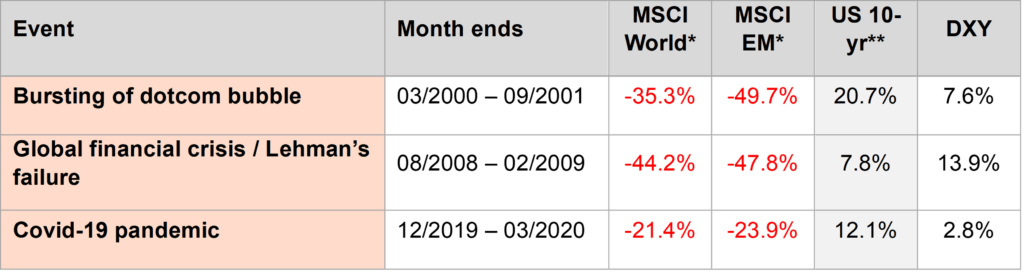 Source: Refinitiv and Denker Capital calculations. *Price returns are reflected. **Total return assuming a constant maturity instrument with coupons reinvested.
Negative correlations and portfolio stability
For the 20-year period between 2000 and 2020, correlations between risky equity assets and the US bond market were consistently negative. Hence, the moniker ‘safe-haven asset’ (an asset that appreciates when growth/risk assets sell off). In times of stress, the US dollar and the US sovereign bond market provided portfolio stability. These were the best of times.
In Table 2, each cell shows the correlation between the returns of the asset in the row and the asset in the column, with positive values indicating assets that move together and negative values indicating assets that tend to move in opposite directions.
Table 2: Correlations between equity markets, sovereign bond market and US dollar returns – monthly data from January 2000 to December 2020

Source: Refinitiv and Denker Capital calculations
A regime shift: bond behaviour to growth risks changed
The central problem today is that US bond duration has shifted from an asset that hedged against growth risks to an asset subject to growth risks.
Since the start of 2021, the relationship between risky equity assets and the US bond market has dramatically altered and is now (unfortunately) positive. The US dollar remains a safe place to hide, but the US bond market is now an asset that declines in value as risk aversion rises and/or growth prospects deteriorate.
Table 3: Correlations between equity markets, sovereign bond market and US dollar returns – monthly data from January 2021 to April 2026

More or less at the time that correlations between risky assets and the market turned positive, bond yields in the US started rising. We know from the difference in yields between vanilla and inflation-protected bond yields that investors continue to think that ~2% inflation remains a reasonable base case in the US. However, the options market¹ tells us that investors are far less certain about the base case. Where in 2020 the likely range of inflation outcomes over five years (10th to 90th percentile) varied from 0.9% to 3.2%, by 2025 the range had drifted significantly wider to 0.7% to 4.9%.
There are a number of contributing factors, but whatever the reason, investors are now of the opinion that the value of a US Treasury note is no longer unaffected by the growth prospects of the US (or global) economy.
Figure 1 shows the yield to maturity and subsequent 10-year returns earned by owning 10-year maturity US sovereign debt.
Three things are worth highlighting:
- the yield at which you buy is a very good indicator of the return you are likely to earn. When yields are low returns are low. When yields are high, returns are higher. When yields go up, it drags on returns and when yields decline, it provides a tailwind to returns;
- investors earned modest, but (mostly) positive returns, from the safe-haven assets in their portfolio; and
- yields are at least higher than they were. This provides some relief to investors that now have far fewer options for building hedged portfolios.
Figure 1: 10-year US Treasury yield vs. next 10-year bond returns

Source: Refinitiv and Denker Capital calculations
Recent stress episodes tell a different story
In Table 4, below, we show two post-Covid periods of equity market stress: the week following the Liberation Day tariff announcements; and the turmoil in the Middle East in March of 2026. Readers should note that these periods of turmoil are short and sharp while our earlier examples extended for months (not just days or weeks).
Table 4: Returns during times of stress

Source: Refinitiv and Denker Capital calculations. *Price returns are reflected. **Total return assuming a constant maturity instrument with coupons reinvested.
There is a clear difference between Table 1 and Table 4. In the former, equity market stress saw positive returns for the US dollar index (DXY) and the US bond market (US 10-yr). In Table 4, the DXY weakened in the week in question in April 2025 and strengthened in March 2026. The bond market in both episodes closed lower.
What is clear from the table is that the different behaviour of the US bond market makes it far harder to protect investors’ capital in times of stress. Bond market duration used to assist in preserving capital values and, although US bonds are not high beta assets (i.e. they decline by less than the equity markets), they do decline.
The rand investor’s experience is different
In our daily lives the volatile rand is usually thought of as a curse but, for the rand investor’s savings, it is an invaluable tool for constructing resilient portfolios. The rand is one of the most volatile currencies globally. This makes the value of offshore assets unusually volatile in rand terms, but during market stress the weaker rand often offsets falls in offshore asset values. For the rand investor, the combination of dollar strength and attractive bond returns in times of stress was doubly valuable.
Building diversified portfolios for the world we have
It is still too early to declare, with confidence, that we have entered a permanent new regime. But the evidence since 2021 is strong enough to change how investors should think about portfolio construction to achieve attractive risk-adjusted returns: US duration can no longer be relied upon to rise when equities sell off.
For most investors, the path of returns matters as much as the destination because:
- drawdowns affect behaviour,
- liquidity needs are real, and
- volatility can reduce compounded wealth.
The practical implication is simple: if the traditional safety of the US bond market is less dependable, investors must be more deliberate about where diversification and protection will come from. For rand-based investors the dollar may still provide valuable protection in stress, but the combination of dollar strength and positive bond returns can no longer be taken for granted.
We may miss the good old days – but portfolios should be built for the world we have, not the world we wish would return.
1 Current and Historical Market-Based Probabilities | Federal Reserve Bank of Minneapolis