South Africa’s economic future remains uncertain. No one knows how ongoing political developments will affect economic policy and what this will mean for economic growth. So how do you invest in this environment? The key is to prepare for a range of possible outcomes, rather than relying on a specific outcome that may not happen. This may mean giving up the chance of earning the highest possible returns (if a forecast happens to be correct), but it also means avoiding the risk of suffering severe losses (if a forecast is wrong). A cautious, diversified approach is more important than ever to ensure you generate sufficient wealth over the long term.
Read the full article below, or watch this short video for the highlights.

Promoting economic growth and wealth creation is only one of many policy options for South Africa.
If South Africa engages in pro-market reforms – as put forward by Professor Brian Kantor in his book, Get South Africa Growing – it is very likely that economic growth would accelerate. Much of the population would benefit from income gains, which means more income will be saved and more wealth created. This is what transpired in the early 2000s as the economy grew more rapidly than expected and the value of stocks and bonds rose. For economic growth to speed up, resources would have to be allocated efficiently. This will require adopting policies that put growth first and other objectives second.
However, the state, and the politically connected beneficiaries of state resources, rely heavily on state-directed economic activity – so it can’t be ruled out. The efficient allocation of resources ranks poorly on their list of policy priorities. More state-owned entities like South African Airways and Eskom would mean slower growth in income, less wealth creation, and increased taxes on income and wealth – which will discourage the generation of both.
There’s no way of knowing what is in store for South Africa.
Will there be more highly regarded ministers fired, more downgrades, and more unsuccessful no-confidence votes? Will the reinvigorated notion of radical economic transformation and white monopoly capital continue to encourage the rapid loss of skills as highly mobile South Africans opt for greener pastures? We don’t know. We have however seen that South Africans are not blind to the dangers. The ANC suffered dramatic losses in the most recent local elections, with DA-led coalitions taking over in Tshwane, Johannesburg and Nelson Mandela Bay. In addition, widespread civil protests suggest that the people, and hopefully their elected representatives, are taking a stand against corruption and self-enrichment in support of good, accountable and honest governance. All this means is that there is hope for growth – but we cannot say with any certainty if and when this potential growth will take place, or what the scope and speed of a recovery will be.
How do you invest to grow and protect your money amidst all this uncertainty?
Your investment outcomes largely depend on how the portfolio you are invested in generates returns – does it rely on a certain outcome for a specific economy or macroeconomic event? And how are other factors that can affect these returns considered? For this discussion, we will focus on three model portfolios, all of which are Regulation 28-compliant (which means they are suitable for saving for retirement):
- A South Africa-dependent portfolio – the returns depend on returns generated by the South African economy, and therefore relies on an improved growth outlook for the local economy.
- An offshore-dependent portfolio – the returns depend on the returns generated by international economies.
- A balanced portfolio – the returns are generated from both the South African economy and international economies, which means they are not solely dependent on the macroeconomic outcome for South Africa.
History shows the risks of relying on one outcome.
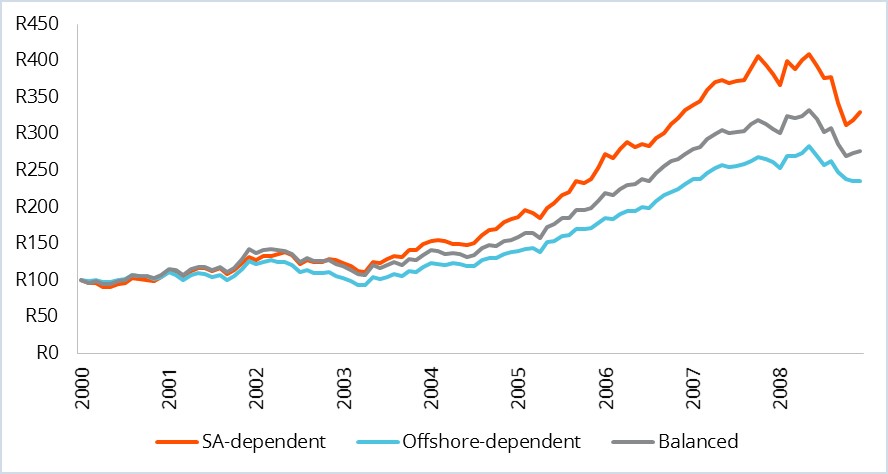
A portfolio that is built on a view that South Africa’s growth outlook will improve, will invest mostly in South African assets (a South African-dependent portfolio). This view assumes that the portfolio will deliver substantial gains to its investors if the economy performs well. On the other hand, the same portfolio would suffer terribly if South Africa does not grow. Figures 1 and 2 illustrate these different scenarios.
Figure 1: Outcomes for three different model portfolios when domestic equities performed well (2000-2008)
Sources: Thomson Reuters and Denker Capital Research
Between 2000 and 2008, South Africa’s economic growth tended to exceed the market’s expectations. This meant that R100 invested in the South Africa-dependent portfolio in 2000 would have grown to R330 by the end of 2008 – an average annualised return of 16.1% per year. Despite the substantial drawdown during the financial crisis in late 2008, this portfolio outperformed both of the alternatives over this period – R100 invested in a diversified balanced portfolio would have grown to R275, an average annual return of 13.5%. The offshore-dependent portfolio would have delivered an even lower return of R235 (an average annual return of 11.3%).
Given these very different outcomes it is easy to understand why investors are tempted to invest in assets based on a macroeconomic view. Investors whose view turns out to be right may be rewarded with superior returns.
In the years after the financial crisis however, the returns generated offshore exceeded those from domestic assets. Figure 2 shows the performance of the same three portfolios, assuming a R100 investment at the start of 2009. Over this period, R100 invested in the offshore-dependent portfolio would have grown to R343 – outperforming both the portfolio tilted towards the South African economy (R290), and the balanced portfolio, with no macroeconomic view (R303). The portfolio with its bias towards offshore assets that delivered poor growth over the previous period is now the top performer. This is clear evidence of the erratic performance of portfolios built on specific macroeconomic views.
Figure 2: Outcomes for three different model portfolios when domestic equities performed poorly (2009-2017)
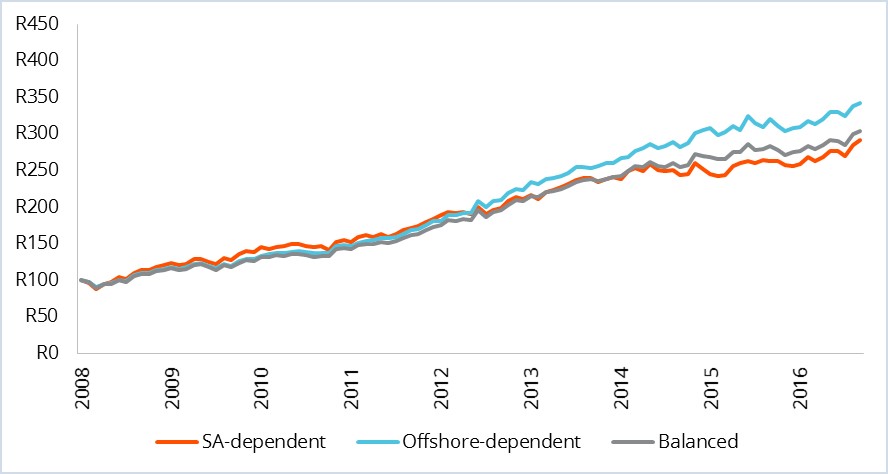
Sources: Thomson Reuters and Denker Capital
There is a trade-off between potentially high returns and protecting what you have.
An investor who invests for the highest possible returns is likely to rely on a specific macroeconomic outcome – even where there is no evidence to support this outcome – with the risk of underperformance and/or capital loss if their view turns out to be wrong. No one knows what the future holds. Investment managers might be keen to take views like this, but it is clients that end up with insufficient savings when the macroeconomic outcomes turn out differently.
For investors saving for a long-term goal such as retirement, owning a diversified portfolio that ensures returns no matter what the future holds is a more appropriate objective than earning the highest returns. This is especially true in highly uncertain environments like we are experiencing now – it is preferable to choose a portfolio that will deliver returns no matter what the future holds (sometimes referred to as an ‘all weather portfolio’). The investment managers of these portfolios manage assets for any macroeconomic outcome and balance the portfolio accordingly. The objective is to earn returns and avoid losing clients’ money, rather than to be the top performer.
With uncertainty being the only certainty, a cautious, diversified approach is essential.
The political developments in South Africa over the next few years and their impact on economic policy, growth and wealth creation will have a significant impact on investors’ wealth and their outcomes. If you want to protect your capital against this backdrop of ongoing uncertainty, now is the time to invest with those who say: ‘We don’t know what is going to happen’, and who build well-diversified portfolios. You may not earn the highest possible returns – as those who may rely on a specific outlook and strike it lucky may do – but we believe that this is an acceptable price to pay to avoid retiring with too little.
Our new balanced fund can help you prepare for the future.
The Denker SCI* Balanced Fund, which is Regulation 28-compliant, was launched in May this year. This portfolio, managed by Madalet Sessions and Jan Meintjes, invests across a wide range of assets, both locally and internationally. Instead of focusing on possible macroeconomic outcomes, which we know we cannot predict, we focus on what we can know. To deliver attractive, risk-adjusted returns, we therefore aim to avoid unnecessary macroeconomic risk. This means the returns are likely to be less volatile than other multi-asset high equity funds. Contact us if you’d like more information about this fund.
Madalet Sessions
Disclaimer
Denker Capital is an authorised Financial Services Provider, and an appointed investment advisor to Sanlam Investment Management (Pty) Ltd an authorised Financial Services Provider. The information in this communication or document belongs to Denker Capital (Pty) Ltd (Denker Capital). This information should only be evaluated for its intended purpose and may not be reproduced, distributed or published without our written consent. While we have undertaken to provide information that is true and not misleading in any way, all information provided by Denker Capital is not guaranteed and is for illustrative purposes only. The information does not take the circumstances of a particular person or entity into account and is not advice in relation to an investment or transaction. Because there are risks involved in buying or selling financial products, please do not rely on any information without appropriate advice from an independent financial adviser. We will not be held responsible for any loss or damages suffered by any person or entity as a result of them relying on, or not acting on, any of the information provided.
The fund’s risk profile is moderate aggressive: In this portfolio, capital growth is important and results in a higher allocation to equities. The portfolio may display capital fluctuations over the shorter term, however, volatility levels should be lower than a pure equity fund. While diversified, this portfolio is tilted more towards equities and other risky asset classes to ensure risk adjusted returns.
Sanlam Collective Investments (RF) (Pty) Ltd (SCI) is a registered and approved Manager in terms of the Collective Investment Schemes Control Act. SIM stands for Sanlam Investment Management.
The information does not constitute financial advice as contemplated in terms of the Financial Advisory and Intermediary Services Act. Use or rely on this information at your own risk. Independent professional financial advice should always be sought before making an investment decision. Sanlam Collective Investments (RF) (Pty) Ltd, a registered and approved Manager in Collective Investment Schemes in Securities. Collective investment schemes are generally medium- to long-term investments. Past performance is not necessarily a guide to future performance, and that the value of investments / units / unit trusts may go down as well as up. A schedule of fees and charges and maximum commissions is available from the Manager on request. Collective investments are traded at ruling prices and can engage in borrowing and scrip lending. The Manager does not provide any guarantee either with respect to the capital or the return of a portfolio. Performance is based on NAV to NAV calculations with income reinvestments done on the ex-div date. Performance is calculated for the portfolio and the individual investor performance may differ as a result of initial fees, actual investment date, date of reinvestment and dividend withholding tax. The manager has the right to close the portfolio to new investors in order to manager it more efficiently in accordance with its mandate. The Manager retains full legal responsibility for the co-brand portfolio. All the portfolio options presented are approved collective investment schemes in terms of Collective Investment Schemes Control Act, No 45 of 2002 (CISCA). The portfolio management of all the portfolios is outsourced to financial services providers authorized in terms of the Financial Advisory and Intermediary Services Act, 2002.