2025 was an exceptionally strong year for the Denker Global Financial Fund. Over the 12 months to 31 December 2025, the fund (A class) returned 47.9% in US dollars – significantly outperforming the fund’s MSCI World Financials Index benchmark return of 28.7%. By comparison, the S&P 500 Index, which many investors use as a benchmark and which has the highest concentration of tech and ‘Magnificent 7’ stocks, generated 16.8% over the period and the MSCI World Index returned 21.1%.
However, this is not about what we did in one year. It reflects what the global financials team has been doing consistently for over 20 years.
The past five years have been particularly good, helped by a favourable operating environment and a broad re rating of parts of the sector. That does distort the longer-term numbers slightly. But even if you strip out the most recent five years, the fund has still delivered attractive long-term returns and meaningful outperformance relative to global equity markets.
Figure 1: Annualised performance since inception vs. benchmark and MSCI World Index
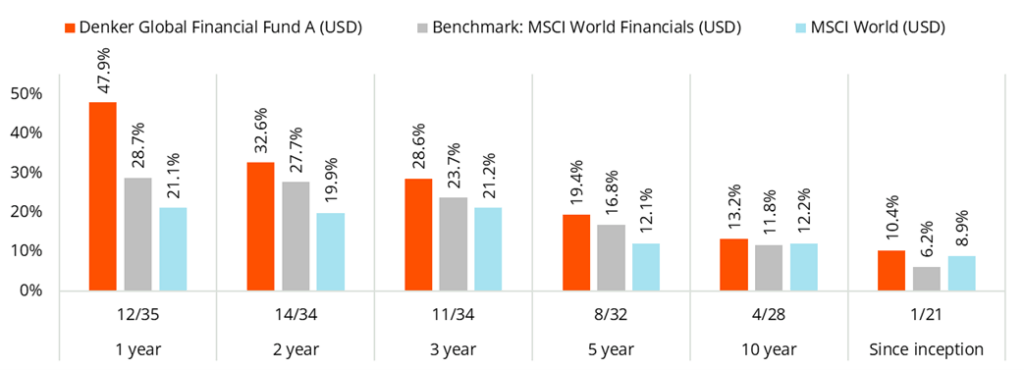
Source: Morningstar, 31 December 2025. Returns for periods longer than one year are annualised. Returns are net of the A class fee of 1.25%. The highest annual calendar return in the last 10 years was 47.9% and the lowest was -17.2%. Morningstar category rank included: EAA OE Sector Equity Financial Services. Category ranks based on returns gross of fees, using oldest fee classes. Past performance is not necessarily a guide to future performance, and the value of investments/units/unit trusts may go down as well as up.
The key question is not only why 2025 was good – but why the fund has been able to outperform through very different cycles.
Putting 2025’s performance into context
The main driver of performance in 2024 and 2025 was a re-rating of banks, particularly in Europe and the UK, and to a lesser extent US investment banks.
However, that re-rating was not the result of a sudden change in fundamentals. Instead, it followed several years in which bank balance sheets and earnings quality improved steadily, even as markets were dominated by Covid-19, ultra-low interest rates, an inflation spike, sharply rising interest rates, the Russian invasion of Ukraine, AI-driven markets and President Trump’s tariff announcements, to name a few. Due to the all the noise the progress was easy to miss. For banks, the environment was fundamentally different from the years leading up to previous crises. Four structural factors mattered most:
- Very low bad debt levels, a result of the regulatory discipline imposed after the 2008 Global Financial Crisis;
- A strong focus on cost control, supported by ongoing digitalisation;
- Wider net interest margins, as interest rates normalised after a prolonged period of negative rates; and
- The end of regulatory capital build-ups after 2008, allowing excess capital to be returned to shareholders.
Together, these factors lifted returns on equity materially, enabling banks to grow shareholder value at a very satisfactory rate.
This cycle also differed in an important way. The major collapses after 2000 and 2008 were driven by excessive lending growth in the run-up to those crises. Since 2008, banks have generally been far more disciplined in growing their loan books. Without aggressive lending to fund speculative excess, the conditions for widespread balance-sheet stress simply haven’t been present.
Fundamentally, the re-rating reflected the market recognising the sustainability of the higher returns on equity.
A few additional factors supported performance during the year:
- Interest rates were not cut as aggressively as expected (lower rates support growth, but rates that are too low compress margins);
- Valuations were low at the start of the year, providing a favourable entry point; and
- The macro environment remained relatively stable, despite ongoing political and geopolitical uncertainty.
Stock selection and geographical allocation also mattered. The fund had relatively small investments in many of the shares with large index weights, and as a result of its heavier exposure to European and UK banks, it was underweight US financials, relative to the benchmark.
Why the fund outperforms over time
The global financials team’s approach has remained remarkably consistent over time, grounded in a few core principles.
1. Experience and learning
The financial sector is complex. Poor operational and underwriting decisions are like landmines – waiting for an event that will trigger the explosion. Experience across multiple cycles helps in identifying those risks early – and, just as importantly, recognising when markets are overreacting.
A strong culture of learning underpins this experience: revisiting past decisions and understanding what worked and what didn’t.
2. Investing in businesses, not shares (as Warren Buffett says)
Investing is about buying a part in a business. We approach buying financial stocks as ownership stakes in operating businesses, not trading instruments.
Strong businesses, run by capable management teams, tend to emerge from periods of stress in better shape than before – and continue to compound shareholder value over time.
It’s about probabilities. We see it every day in the world of sport. Better coaches with better players will over time more consistently make the right decisions and generate better results.
3. Not overpaying
Since 1999, we’ve built up a deep database of banks and insurers around the world, allowing us to quickly identify and place new players, ones we don’t know and ones that are being turned around. We’ve back-tested what the hallmarks of a good financial company are, and when a good quality business is too expensive.
The investment balance of probabilities is in your favour when you get the balance right: Quality at the right price.
The contrast between JPMorgan and Barclays is a good illustration of why valuation alone is not enough.
After the Global Financial Crisis, Barclays appeared really cheap, trading at a large discount to tangible book value. However, the business required extensive restructuring, capital rebuilding and strategic repositioning, which took more than a decade to complete. For much of that period, shareholder value growth was limited.
JPMorgan, by contrast, entered the crisis with a stronger business model and balance sheet. While it never looked “cheap” on traditional metrics, it consistently grew intrinsic value through the cycle. Over time, that compounding delivered meaningfully better long-term returns.
The lesson was clear: buying deep value only works if the underlying business is sound and capable of growing shareholder value.
National Bank of Greece illustrates the other side of the valuation-quality balance.
Following years of economic crisis, the Greek banking system had been through extensive restructuring. By the time the fund invested after meeting with the management team of the National Bank of Greece, balance sheets were materially stronger, capital levels were adequate and bad debts were declining – yet valuations still reflected extreme pessimism.
Careful entry points and disciplined position sizing allowed us to participate meaningfully as confidence returned and the market began to recognise the improvement in fundamentals.
4, A clear circle of competence
In managing the fund, we operate within a clearly defined circle of competence. By focusing exclusively on global financials, the team is better equipped to understand balance sheets, regulatory dynamics and risk factors that generalist investors often underestimate.
This focus also supports better risk management – through diversification, position sizing and geographic balance – particularly in areas such as emerging markets.
5. Controlling emotions
Experience only adds value if it is paired with emotional discipline. Markets regularly overshoot – both on the upside and the downside – and financial stocks are often among the first to be sold when uncertainty rises.
Controlling emotions means resisting the temptation to chase what has already performed well, and being willing to add to good businesses when sentiment is poor but fundamentals remain intact. This discipline has been critical in recycling capital out of winners, maintaining exposure to laggards with improving fundamentals, and taking advantage of opportunities created by market overreactions.
Looking ahead
2025 was an outstanding year, but it was not an anomaly. It was the result of a disciplined, specialist approach that has been applied consistently for more than two decades.
One cannot forecast what markets will do. Markets will continue to change, and cycles will come and go. We remain focused on the same task as always, which has worked over the long term: investing in good-quality financial businesses, with strong management teams, at sensible valuations, and allowing shareholder value to compound over time.
We are really looking forward to 2026 and beyond.
For more information on the Denker Global Financial Fund, please click on the links below or contact us.
Minimum disclosure document (fact sheet)
For more information, please see the KIID which can be found here.
Please read and understand the minimum disclosure document (fact sheet) before investing.